Nylock Nuts

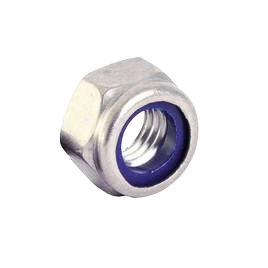
A prevailing-torque nylon lock nut manufactured to DIN 982 / ISO 7040 — the most widely used vibration-resistant nut in industrial, automotive and structural assembly. The nylon insert locks the nut in place without adhesives or additional hardware. Available in MS zinc plated, SS 304 and SS 316 in metric M5 to M22. Ready stock Bengaluru.
Material
MS Zinc · SS 304 · SS 316
Standard
DIN 982 · ISO 7040
Size Range
M5 – M22
Nylock Nut — DIN 982 / ISO 7040 nylon lock nut

What is a Nylock Nut?

A nylock nut — also known as a nylon lock nut or prevailing-torque lock nut — is a standard metric hex nut with a nylon insert collar crimped into its top face. When threaded onto a bolt, the nylon ring deforms around the bolt threads and creates a controlled frictional grip that resists self-loosening under vibration, dynamic loading, and thermal cycling. No spring washer, thread locker, or locking wire is required — the locking action is built into the fastener.

Manufactured to DIN 982 / ISO 7040, nylock nuts are the most widely used vibration-resistant nut in general industry. RM Traders stocks them in MS zinc plated for standard environments, SS 304 for moderate corrosion resistance, and SS 316 for marine, chemical, and food-grade applications — in metric sizes M5 to M22.

MS Zinc Plated
Standard carbon steel with electro-zinc coating. General machinery, automotive, structural, and indoor industrial use. Cost-effective and widely stocked.
SS 304 (A2)
Austenitic stainless steel. Outdoor structures, light industrial, food-adjacent equipment, and mildly corrosive environments where zinc plating is inadequate.
SS 316 (A4)
Molybdenum-bearing stainless. Superior chloride resistance for marine fittings, coastal installations, chemical plant piping, and pharmaceutical/food-processing equipment.

Standards & Specifications

Nylock nuts are manufactured and tested to international standards covering dimensions, thread tolerance, and minimum prevailing-torque performance:

  • DIN 982 / ISO 7040 — Prevailing-torque type hexagon nuts with non-metallic insert, style 2 (nut height ≥ nominal diameter). Specifies across-flat dimensions, overall height (h), metal-section height (m), nylon insert position, and minimum prevailing-off torque for each size. DIN 982 and ISO 7040 are technically equivalent and fully interchangeable.
  • Thread tolerance 6H — Standard internal thread fit per ISO 965. Compatible with all metric 6g bolts and studs in the same size range.
  • Nylon insert material — Polyamide (PA 6/6) — Rated for continuous service up to 120°C. Not suitable for temperatures above 120°C, strong acids, or chlorinated solvents.
  • Prevailing-torque performance — Per DIN 982 / ISO 7040, minimum prevailing-off torque is tested after five installation/removal cycles. Locking performance must be maintained across all five cycles.
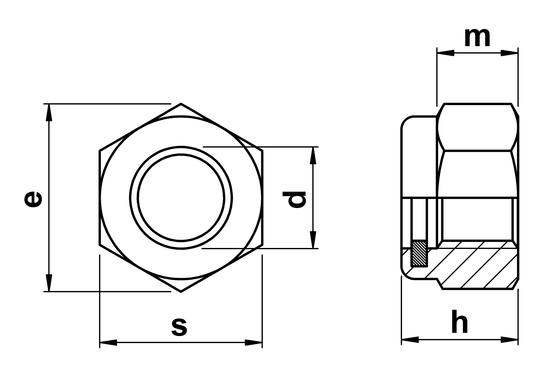
Technical Drawing & Dimensional Tolerances

Nylock nut technical drawing showing across flats (s), overall height (h), metal height (m) and nylon insert per DIN 982 / ISO 7040
DIN 982 · ISO 7040 Thread 6H · PA Insert

Key dimensions: s = Width across flats · e = Width across corners · h = Overall height (incl. nylon) · m = Metal-section height

Size Pitch P (mm) A/F — s nom (mm) s min (mm) A/C — e min (mm) Height h max (mm) h min (mm) Metal m min (mm)
M50.8087.788.796.36.04.4
M61.00109.7811.058.07.74.9
M71.001110.7312.128.58.26.14
M81.251312.7314.389.59.146.44
M101.501716.7318.9011.511.148.04
M121.751918.6721.1014.013.6410.37
M142.002221.6724.4916.015.3012.10
M162.002423.6726.7518.017.3014.10
M182.502726.1629.5620.019.1615.10
M202.503029.1632.9522.020.7016.90
M222.503231.0035.0325.023.7018.10

All dimensions in mm per DIN 982 / ISO 7040 — Product Grade A. Thread tolerance 6H. h = overall nut height including nylon insert · m = minimum metal (load-bearing) section height · s = across flats · e = across corners minimum.

Sizes Available

Nylock nuts are stocked in M5 to M22 in all three materials. All sizes are metric coarse pitch per DIN 982 / ISO 7040.

MS Zinc Plated · SS 304 · SS 316 — Metric (M5 – M22)
Size × Pitch MS Zinc Plated SS 304 (A2) SS 316 (A4)
M5 × 0.8
M6 × 1.0
M7 × 1.0
M8 × 1.25
M10 × 1.5
M12 × 1.75
M14 × 2.0
M16 × 2.0
M18 × 2.5
M20 × 2.5
M22 × 2.5
Note: Sizes above M22 and fine-pitch variants available on enquiry with MOQ. The nylon insert in all nylock nuts is polyamide (PA 6/6) — rated to 120°C continuous. Do not specify nylock nuts for applications exceeding this temperature.

Applications

Nylock nuts are the preferred vibration-resistant fastener wherever joints experience dynamic loads, engine vibration, or repeated thermal cycling — and where regular disassembly is required. They eliminate the need for secondary locking hardware in most standard applications.

Automotive & Two-WheelersEngine mounts, suspension links, brake calipers, bodywork panels, and exhaust brackets where vibration resistance is essential.
Industrial MachineryConveyor drives, pump flanges, gearbox covers, and compressor housings subject to continuous vibration and periodic maintenance access.
Electrical & Panel WorkControl panel frames, switchgear enclosures, cable tray fixings, and electrical conduit supports — nylock nuts prevent loosening from motor/transformer hum.
Furniture & FitoutsCommercial furniture, racking systems, shelving, and modular office partitions where re-torquing is impractical after installation.
Marine & OutdoorSS 316 nylock nuts for marine deck hardware, pontoon fixings, and coastal structural connections subject to salt spray and wave action.
Food & PharmaceuticalSS 316 nylock nuts on food-processing equipment, pharmaceutical machinery, and CIP-cleaned surfaces — corrosion-resistant and hygienic.

Frequently Asked Questions

What is a nylock nut?
A nylock nut — also called a nylon lock nut — is a standard hex nut with a nylon insert collar pressed into the top section. When threaded onto a bolt, the nylon deforms around the bolt threads and creates a frictional grip that prevents the nut from self-loosening under vibration or dynamic loads. No spring washers, locking wire, or adhesive is required — the locking mechanism is built in. Manufactured to DIN 982 / ISO 7040, RM Traders stocks nylock nuts in MS zinc plated, SS 304, and SS 316 in sizes M5–M22.
How does a nylock nut work?
The locking action is purely mechanical. The nylon insert inside the nut has an opening slightly smaller than the bolt's nominal diameter. As the bolt passes through, the nylon elastically deforms and grips the thread flanks — creating a prevailing torque (constant resistance to rotation) that keeps the nut in place under vibration. Unlike Loctite thread lockers, the locking force is immediate and requires no curing time. Per DIN 982 / ISO 7040, minimum prevailing-off torque values are specified for each size, ensuring consistent, testable locking performance across all production batches.
Can nylock nuts be reused?
Nyloc nuts can be reused 3 to 5 times provided the nylon insert still generates adequate prevailing torque. Each use deforms and wears the nylon slightly, reducing grip. For safety-critical or high-vibration applications — automotive, structural, aerospace — replace nylock nuts at every disassembly without exception. For general maintenance and non-critical uses, reuse is acceptable as long as the nut still resists rotation when threaded by hand. Discard any nylock nut where the nylon ring is cracked, discoloured (from heat), or no longer provides resistance on threading.
What is the maximum temperature a nylock nut can handle?
Standard nylock nuts use a polyamide (nylon PA 6/6) insert rated to 120°C continuous service. Brief exposure to 150°C may be tolerated, but above this the nylon softens, loses its elastic grip, and the locking function is lost. Never use nylock nuts on exhaust systems, engine hot-zones, industrial ovens, or any application above 120°C. For high-temperature locking, specify all-metal prevailing-torque nuts (DIN 980), distorted-thread types, or use thread-locking compound rated for the required temperature. Nyloc nuts are also not suitable for strong acids or chlorinated solvents that attack nylon.
What is the difference between DIN 982 and ISO 7040?
DIN 982 is the German standard for prevailing-torque hex lock nuts with a non-metallic (nylon) insert — style 2, where the nut height equals or exceeds the nominal bolt diameter. ISO 7040 is the international standard and is technically identical to DIN 982 for metric coarse-pitch sizes: same across-flat dimensions, same height, same nylon insert specification, same prevailing-torque requirements. A DIN 982 and ISO 7040 nylock nut of the same size are fully interchangeable. RM Traders stocks to both standards simultaneously.
Should I choose MS zinc plated, SS 304, or SS 316 nylock nuts?
MS zinc plated nylock nuts suit indoor, dry, or mildly humid environments — general machinery, automotive chassis, electrical panels, and furniture. The zinc coating provides basic corrosion protection. SS 304 is specified where moderate corrosion resistance is required: outdoor structures, food-adjacent equipment, and light industrial environments. SS 316 adds molybdenum for superior chloride resistance — the correct choice for marine fittings, coastal installations, chemical plants, and food-processing equipment with CIP wash-down. All three materials are stocked in M5–M22 at RM Traders.
How does a nylock nut compare to a spring washer for vibration resistance?
Nyloc nuts are significantly more effective than spring (split) washers under vibration. The Junker vibration test (DIN 65151) — the industry standard for vibration resistance testing — consistently shows that split spring washers lose their locking ability within a few vibration cycles and are essentially ineffective in severe vibration conditions. Engineering consensus now discourages spring washers for critical joints. Nyloc nuts maintain positive prevailing torque across many cycles and do not rely on bolt preload to function. For maximum security in very high-vibration applications, a nylock nut can be combined with a thread locker — or specify an all-metal prevailing-torque nut.
Can nylock nuts be used outdoors or in marine environments?
Yes — with the correct material choice. MS zinc plated nylock nuts have limited outdoor durability; zinc corrodes in coastal or salt-spray environments within months. For outdoor structural use, specify SS 304 nylock nuts. For marine, waterfront, or saltwater-exposed applications, specify SS 316 nylock nuts — the molybdenum content resists pitting corrosion from chlorides. In all outdoor conditions, the nylon insert itself is stable: it is UV-resistant and unaffected by moisture. Only elevated temperatures above 120°C or chemical exposure (acids, chlorinated solvents) will degrade the nylon locking element.
Ready to order?

Need Nylock Nuts?
Quote within the hour.