Spring Washers

Helical split lock washers that maintain bolt clamping force under vibration, thermal cycling, and dynamic loading. Available in spring steel, stainless steel SS 304, and EN 42J high-carbon spring steel. DIN 127B. M2 to M36 ready stock Bengaluru.
Material
Spring Steel · SS 304 · EN 42J
Standard
DIN 127B
Size Range
M2 – M36 (stock) · M42–M100 on order
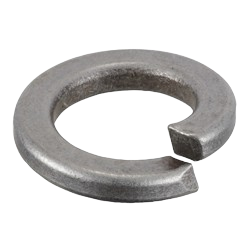
Spring washer — DIN 127B split lock washer in spring steel and stainless steel

What is a Spring Washer?

A spring washer — also called a split lock washer or helical spring washer — is an open-ended single-coil washer with a helical split. Unlike a plain flat washer which provides no locking action, the spring washer acts as a mechanical spring under the bolt head or nut. When tightened, the washer compresses flat, storing elastic energy that maintains clamping force as the bolted joint experiences vibration, thermal expansion and contraction, or mechanical settlement.

The DIN 127B profile specifies a square cross-section (wire width ≈ wire height), which delivers higher spring force and greater resistance to flattening compared to the Type A rectangular profile. Additionally, the sharp hardened edges at the split bite into both the fastener bearing face and the mating surface, creating a mechanical resistance to rotational back-off. RM Traders stocks DIN 127B spring washers in spring steel (zinc plated), stainless steel SS 304, and EN 42J high-carbon spring steel from M2 to M36.

Spring Steel — Zinc Plated
Standard · Most Common
High-carbon steel heat-treated to HRC 44–52. Highest spring force and bite energy of all material options. Electro zinc plated (BZP) for basic indoor corrosion protection. Used in general machinery, electrical panels, motor mounts, and all standard fabrication. Not suitable for outdoor or corrosive environments without additional protection.
Stainless Steel SS 304 (A2)
Corrosion Resistant
Austenitic stainless steel for outdoor, marine-adjacent, food, chemical, and pharmaceutical environments. Lower spring constant than carbon steel, but maintains performance up to ~300°C. Fully corrosion resistant without additional coating. Specify SS 316 (A4) for chloride-rich marine or chemical environments — available on request.
EN 42J — High Carbon Spring Steel
Indian Standard Grade
EN 42J is a high-carbon (≈0.75–0.85% C) spring steel grade per the British Standard BS 970 adopted in Indian manufacturing. Hardened and tempered to HRC 44–52, providing excellent elasticity and fatigue life under cyclic loading. Specified by Indian OEM customers who require EN 42J material certification. Dimensionally identical to DIN 127B spring steel washers.

How a Split Lock Washer Works

The locking mechanism of a DIN 127B spring washer operates through two distinct actions working in parallel:

  • Spring preload maintenance — The helical body acts as a spring between the nut and the mating surface. As the joint experiences vibration, thermal contraction, or embedment relaxation that would reduce bolt preload, the spring washer expands and maintains the axial clamping force, delaying loosening.
  • Edge bite — The sharp, hardened edges at the split dig into both the nut bearing face and the surface below. This mechanical grip directly resists rotational back-off of the nut. The bite force is proportional to the spring load — fully compressing the washer maximises the edge grip.
  • Correct torque is critical — The washer must be fully compressed (seated flat) at the final torque. If the washer is still visibly helical after tightening, the joint is undertorqued. An incompletely compressed spring washer has minimal locking effect.
  • Single use — Once a spring washer has been compressed flat and unloaded, it has experienced plastic set and should not be reused. Its spring energy is depleted; reinstalling it provides no meaningful locking action.
Best practice pairing: Use a spring washer together with a plain washer. The plain washer goes directly against the base material (distributes load, protects the surface), and the spring washer goes between the plain washer and the nut. This prevents surface damage from the spring washer's sharp edges and ensures the edge bite acts against a hardened, consistent surface for maximum effectiveness.

Standards & Specifications

  • DIN 127B — German standard for helical spring lock washers, square cross-section (Type B). Specifies inner diameter (d1), outer diameter (d2), wire cross-section (s), and free height (h) before compression. Sizes M2 to M100.
  • Spring steel material — Carbon spring steel per DIN 17221 or equivalent. Hardened and tempered to 420–490 HV (≈ HRC 44–52). Surface: electro zinc plated per DIN 50961 / ISO 2081, typically 5–8 µm thickness.
  • Stainless steel — AISI 304 (SS 304 / A2) per DIN EN ISO 3506. Hardness ≥ 195 HV. Passivated finish. SS 316 (A4) available on request for marine or chemical environments.
  • EN 42J — High-carbon spring steel per BS 970 (British Standard, Indian manufacturing reference). Chemical composition: C 0.70–0.85%, Mn 0.50–0.80%, Si 0.10–0.35%. Hardened and tempered HRC 44–52. Material test certificates available.
  • Finish — Spring steel: electro zinc plated (BZP/YZP), bright or yellow passivated. Stainless: self-passivating — no additional coating. EN 42J: zinc plated or as-tempered per customer requirement.
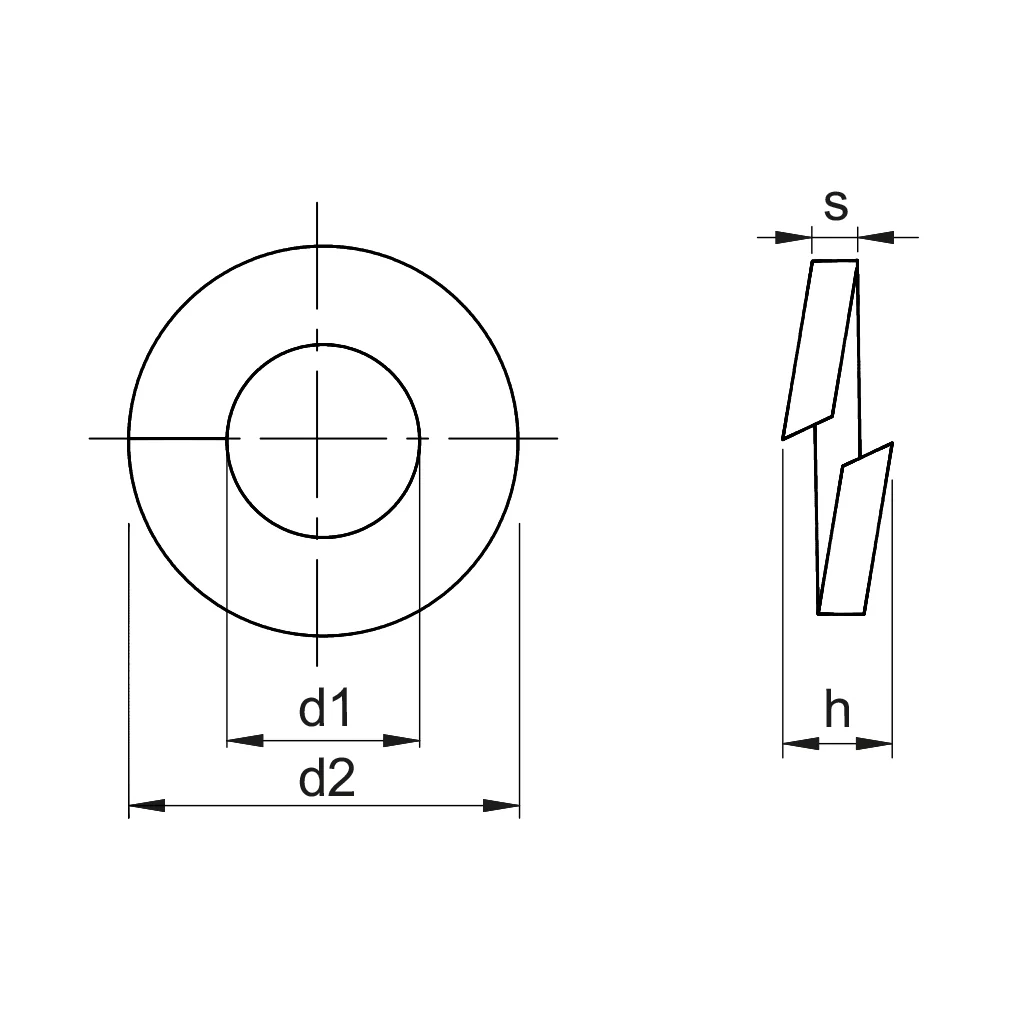
Technical Drawing & Dimensional Tolerances

Spring washer technical drawing — DIN 127B showing d1 inner diameter, d2 outer diameter, s cross-section, h free height
DIN 127B Square Cross-Section

d1 = Inner diameter (bore) · d2 = Outer diameter · s = Wire cross-section (square) · h = Free height before compression · All dimensions in mm per DIN 127B.

Size For Thread d1 min d2 max s (mm) Free height h (mm)
(mm) (mm) minmax
2M22.14.40.5 ±0.11.01.2
2.5M2.52.65.10.6 ±0.11.21.4
3M33.16.20.8 ±0.11.61.9
3.5M3.53.66.70.8 ±0.11.61.9
4M44.17.60.9 ±0.11.82.1
5M55.19.21.2 ±0.12.42.8
6M66.411.81.6 ±0.13.23.8
8M88.114.82.0 ±0.14.04.7
10M1010.218.12.2 ±0.154.45.2
12M1212.221.12.5 ±0.155.05.9
14M1414.224.13.0 ±0.156.07.1
16M1616.227.43.5 ±0.27.08.3
18M1818.229.43.5 ±0.27.08.3
20M2020.233.64.0 ±0.28.09.4
22M2222.535.94.0 ±0.28.09.4
24M2424.540.05.0 ±0.210.011.8
27M2727.543.05.0 ±0.210.011.8
30M3030.548.26.0 ±0.212.014.2
36M3636.558.26.0 ±0.212.014.2

All dimensions in mm per DIN 127B. d1 = inner bore diameter (min) · d2 = outer diameter (max) · s = wire cross-section (square profile) · h = free height before compression. Sizes M39 to M100 available on special order — contact RM Traders with quantity and material requirement.

Sizes & Material Availability

Stock range by material. All metric sizes per DIN 127B. Larger sizes M39–M100 available on order with MOQ.

Spring Washers — Material Availability (DIN 127B)
Size Range Spring Steel (BZP) SS 304 (A2) EN 42J
M2 – M5
M6
M8
M10
M12
M14 – M16
M18 – M20On order
M22 – M24On order
M27 – M36On orderOn order
M39 – M100On orderOn orderOn order
SS 316 (A4) also available — Marine-grade stainless steel spring washers for coastal, offshore, and chemical plant environments. Contact us for sizes and lead time.

Yellow zinc (YZP) and hot-dip galvanised (HDG) spring steel spring washers available for outdoor structural applications — enquire for availability.

Applications

Electric Motors & PumpsUnder terminal box bolts, bearing cap fasteners, and frame bolts on rotating equipment where continuous vibration is present. Use spring steel BZP for indoor motors, SS 304 for process pumps.
Compressors & BlowersHigh-frequency reciprocating and rotary compressors generate extreme vibration — spring washers on all cover and mounting fasteners prevent gradual loosening during extended operation.
Electrical Panels & SwitchgearDIN rail mounting bolts, busbar fixings, and cable gland assemblies where vibration from nearby equipment could work loose critical connections over time.
Automotive & Vehicle AssemblyBattery terminals, engine ancillary mounting, body panels, and chassis bolts. EN 42J grade specified by Indian automotive OEMs for spring washer applications.
Structural Steel & PipeworkUsed with plain washers on pipe flange bolts, handrail brackets, and secondary structural connections where bolts may be retorqued during service.
HVAC & DuctingFan mounting bolts, duct support hangers, and AHU frames. Spring washers prevent loosening from motor vibration transmitted through the structure.

Frequently Asked
Questions

What is a spring washer and how does it work?
A spring washer (split lock washer) is a helical, open-ended single-coil washer that acts as a spring under the nut or bolt head. When tightened fully, it compresses flat — storing elastic energy that maintains bolt preload under vibration and thermal cycling. The sharp edges at the split also bite into both the fastener and the mating surface, mechanically resisting rotational back-off. DIN 127B specifies the square cross-section Type B profile, providing higher spring force than the rectangular Type A. RM Traders stocks DIN 127B in spring steel, SS 304, and EN 42J from M2 to M36.
What is the difference between DIN 127B Type A and Type B?
DIN 127A has a rectangular cross-section (width > height) — a softer spring suited to lighter assemblies. DIN 127B has a square cross-section (width = height) — a stiffer spring with higher stored energy and greater edge bite. DIN 127B is the general engineering standard and what RM Traders stocks as the default. Specify Type A only if your drawings call for it explicitly.
Can a spring washer reliably prevent bolt loosening under vibration?
Spring washers provide moderate vibration resistance suitable for general-purpose assemblies. However, Junker vibration test data shows spring washers flatten quickly under high dynamic loading. For safety-critical or high-vibration joints (motors, compressors, structural bolts), a nylock nut (DIN 982) or thread-locking compound provides more reliable locking. Spring washers remain the cost-effective standard choice for general electrical, HVAC, and assembly applications with moderate vibration.
What is EN 42J spring steel?
EN 42J is a high-carbon steel grade (≈0.75–0.85% C) per BS 970, widely used in Indian manufacturing for spring components. Hardened and tempered to HRC 44–52, it provides excellent elasticity and fatigue resistance under cyclic loading. EN 42J washers are dimensionally identical to DIN 127B spring steel washers — the difference is material grade, certification, and traceability. RM Traders can supply EN 42J spring washers with material test certificates for OEM and government procurement requirements.
At what temperature do spring washers lose effectiveness?
Carbon spring steel and EN 42J spring washers begin losing their temper above 200°C — sustained heat above this causes permanent set (the washer stays flat and loses spring action). For up to 300°C, use SS 304 stainless steel spring washers. Above 300°C, switch to disc (Belleville) springs or a different locking method. SS 304 spring washers are also preferred in environments with high moisture or chemical exposure where carbon steel would corrode despite zinc plating.
Should I use a spring washer alone or with a plain washer?
Always pair a spring washer with a plain washer in the correct order: plain washer against the base material first, then spring washer between the plain washer and the nut. The plain washer distributes bolt load, protects the surface from damage by the spring washer's sharp edges, and provides a consistent hardened face for the edge bite. For bolts Grade 8.8 and above, use a hardened 200HV plain washer — a soft MS plain washer can embed under high preload.
When should I use a nylock nut instead of a spring washer?
Choose a nylock nut (DIN 982) over a spring washer when: (1) the joint faces continuous or high-frequency vibration (motors, fans, compressors); (2) the joint is safety-critical; (3) the base material is too soft or delicate for spring washer edge-bite; (4) you want a simpler one-piece solution. Use a spring washer when: retrofitting existing hex nut assemblies, working on moderate-vibration assemblies where cost and simplicity matter, or where the installation envelope prevents a thicker nylock nut.
What is the correct installation of a spring washer — and can it be reused?
Install the spring washer directly under the nut (or bolt head), above any plain washer. Tighten until the washer is fully compressed and flat — the helical gap must close completely. If the gap is still open, the joint is undertorqued. Do not reuse spring washers — once compressed and unloaded, they have experienced plastic set and lost their spring energy. A reused spring washer provides no meaningful locking action. For critical or frequently-serviced joints, switch to a nylock nut or thread locker instead.
Ready to order?

Need Spring Washers?
Quote within the hour.